The Vaiphei's are one of the Hill tribes of Manipur and Assam belonging to the Kuki-Chin-Mizo Groups. It is one of the recognized schedule tribes in India.

              The origin of the Vaiphei is shrouded in mystery as in the case of any other tribes as there are no such written records to refer, as it is a belief amongst the elder people of the tribe as it is considered to be an oral myth delivered from generation to generation. The Vaipheis believed that they had originated from a cave called "Khul‟. This theory of Khul origin is also supported by legend and folk songs of the Vaipheis living in India, Myanmar and in other parts of the World. The initial documented history of the Vaiphei Tribe started with the arrival of the British in the nineteenth century. The accounts of British expeditionary officers or agents and Christian missionaries during their time in Manipur constitute the earliest written documents. Even in some of these books the name Vaiphei is often missing.

            Recently with the advancement in technology, it has become possible to access Libraries across the world through “Worldcat” and “OPAC”. Most written history with respect to vaiphei has been collected which will be discussed in brief on this page.

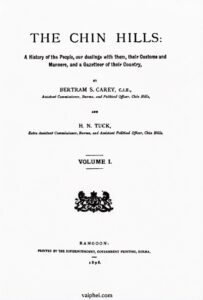
1.	Bentram S.Carrey (Assistant Commissioner Burma and Political Officer Chin hills) and H.N Tuck (Extra Assistant Commissioner Burma and Assistant Political Officer Chin hills) in their book “The Chin Hills-A history of the People, our dealings with them, their customs and manners and a gazetter of their countries” in 1869 has stated that Waipies known as the vaipes left traces of fortifications in the north which will last for many years to come. Perched on the summit of precipitous peaks they built their villages, and if the approaches were not almost perpendicular they proceeded to so cut away and block the paths that friend and foe alike could only ascend to the heavily stockaded gates in single file. On the summit of Lunglen peak is found the remains of an ancient Vaipe village, which was defended in a most extraordinary manner by boulders and sungars. Finally, just in front of the fortified gate, the rock had been cut perpendicular for 10 feet, which necessitated the use of a ladder before it could be scaled. though the remains of their former strongly fortified villages are found on the summits of the high hills on the north-eastern border of Lushai and the south-western border of Manipur.

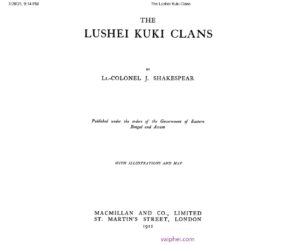
2.	Lt.Colonel J.Shakespear in his book “The Lushai-Kuki Clans"  which was published under the orders of the Government of Eastern Bengal and Assam in 1912 have classified Vaiphei Tribe under the old kuki clans. The book traced the origin of the vaiphei to a village site called Vai-tui-chhun a short distance from Aizawl which is also known as the watering place of the Vai—which is said to commemorate a former settlement of the Vaiphei. It seems probable, therefore, Vaiphei left their former homes in consequence of the forward movement of the Lusheis.

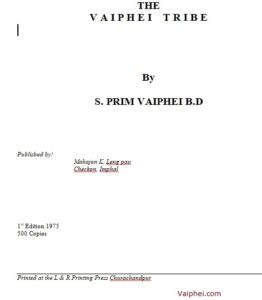
3.	S.Prim Vaiphei in his book, “The Vaiphei Tribe” published by Mahajon K. Lengpau in 1975 refer to Vaiphei as one of Kuki Chin Groups who came from Chin Hills to Manipur.

4.	Vumson in his book “Zo History” published around 1987 has suggested that Zo people originated in China and Vaiphei as one of the clans of Zo.

5.	Navi Songtinlam in his book “Chin-Kuki-Mizo-Zomi-Hmar” published by Vaiphei Literature Society, 1997 identifies Vaiphei as descendants one of the lost tribe of Israel (Manmasi/Manasseh).

Sources:


(# This page is currently under development)
Source : 1.Carry and Tuck Chin hills
Source: 2. Col J Shakespear “The Lushei Kuki Clans”
Source: 3. Prim Vaiphei -“The Vaiphei Tribe”